Health & Fitness Desk · August 2026 · 9 min read
He Was "Skinny Fat" His Whole Life, and No Diet Ever Touched It. A Scan Showed Him It Was Never Fat
[ a lean man shirtless at the mirror, slim arms and frame but a soft lower belly pushing out, a small cross-section scan inset in the corner ]
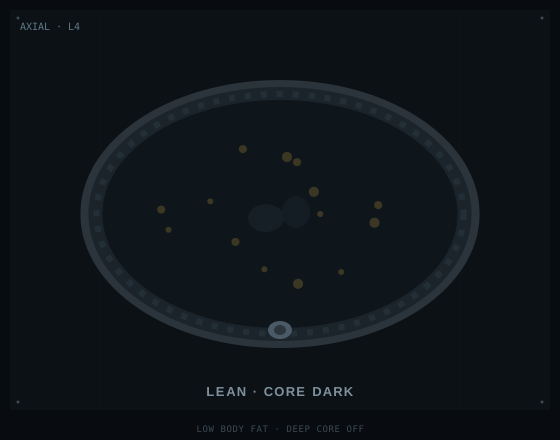
Rohan booked the scan to settle it. Lean, careful with his food, certain the soft belly he had hated for years was just the last bit of fat to lose.
Then the image came up, and there was almost no fat to find.
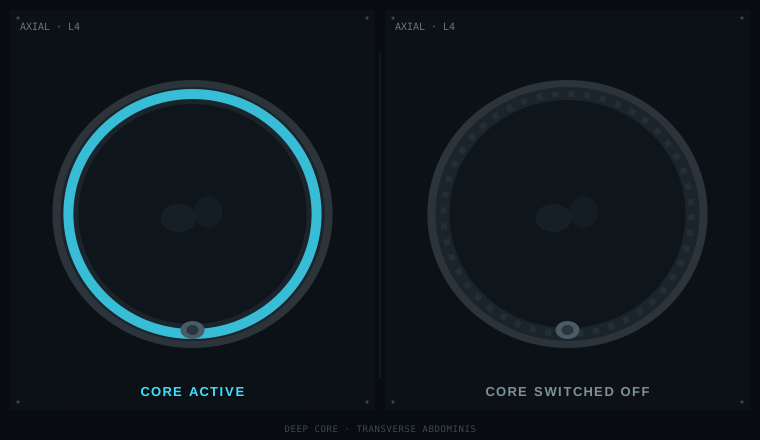
The specialist had seen it a hundred times. A slim man with a soft belly that would not shift, and nothing there to lose. The softness was not fat. It was the deep muscle that wraps the waist and holds the stomach flat, sitting quiet and dark on the screen, switched off. Nothing was holding Rohan's wall in, so even his lean stomach pushed out.
This is the body men call skinny fat, and it is why every fix he had tried failed. You cannot diet off a muscle that is already asleep. The leaner he got, the more that soft middle stood out against the rest of him.
WHY BEING LEAN HID IT
Thin Was Never the Same as Held-In
Here is what being lean hides. You can carry almost no fat and still have a deep core that has never once switched on.
It is not a muscle you use on purpose. It works quietly in the background, holding your middle in without you thinking about it, and if it never gets asked to, it just stays asleep. Being slim does not wake it. It only makes it easier to ignore, because there is no fat on top to blame.
That is why the years of dieting changed nothing about the shape. Losing fat cannot switch on a muscle. And the crunches and planks Rohan tried fire the surface abs that flex, while the deep one underneath stays quiet.
So the belly kept its softness no matter how lean he got. Nothing was holding it flat.
The fix was never going to be another diet. It was waking the one muscle he had never actually used.
The Fix
How You Switch It Back On
Think of your frame as a tent.
The fabric is your skin and the surface muscles, and it is fine. The centre pole is the deep core, and that is the pole that went down.
This is why nothing you tried worked. Sucking in, sitting up straight, a posture brace, another set of crunches, all of it is you grabbing at the fabric of a tent whose pole is lying on the floor. You cannot prop a tent up from the outside. You have to stand the pole back up.
[ two tents, one taut with the centre pole standing, one sagging with the pole collapsed, deep core on / off ]
So how do you stand up a muscle that stopped listening?
You send it the signal yourself. The chair stopped telling the muscle to fire, so you tell it directly, from the outside. That is all EMS is. Electrical muscle stimulation. A gentle current that reaches the deep muscle the way your own nerves used to, and makes it contract fully, the way a hard plank would, except it does not need you to hold anything.
[ a flat pad on the lower stomach, the signal reaching the deep core, the muscle contracting ]
One twenty-minute session is around twenty thousand of those contractions.
You could not do twenty thousand of anything. A brutal ab workout might get you a few hundred before your form falls apart. This just keeps firing the muscle, clean, for twenty minutes.
[ a hard ab set reaching a few hundred reps vs EMS firing 20,000 clean contractions ]
And here is the part that makes it fit a life like yours.
You do it sitting down. At your desk, in the same chair, under your shirt, while you answer emails or watch something. The eight hours that switched the muscle off are now holding the twenty minutes that switch it back on. Nothing added to your day. No gym, no hour away, no willpower to run out of.
It does one thing, and it does it well. It switches a muscle back on. It will not melt fat, and we are not going to pretend it does.
The Catch
Why You Could Never Get This Until Now
If EMS can do all that, your next thought is fair: then why haven't I heard of it, and why is my feed full of belts that clearly do nothing?
Two reasons.
The first is that EMS is not new, and it was never cheap. Physiotherapists have used it for sixty years. It is how they wake a muscle that shut down after an injury, and how athletes reach the deep fibres ordinary training never touches. It was built for exactly your situation: a healthy muscle that simply stopped getting the signal.
Dr. Michael Brennan, a physiotherapist who has run clinical EMS for over six years, puts it plainly: the tech was never the problem. Access was.
[ clinical EMS setup in a physio clinic, electrodes on a patient's midsection, a technician beside the machine ]
Because until recently, getting real EMS meant a clinic.
Forty to sixty thousand rupees for a course, by appointment, across town, on someone else's schedule. For a man whose whole problem is that he has no time, that was never going to happen.
The second reason is the junk.
The buzzing belts all over your feed are toys. They tickle the skin and vibrate. They never reach the deep muscle, because reaching it takes a real signal, not a rattle. You tried to picture EMS and pictured one of those, and wrote the whole thing off. Fair. They earned that.
[ split, cheap vibrating belt (toy, surface tickle) vs flat clinical-grade pad (real EMS, reaches the deep core) ]
What changed is that a team of engineers and physiotherapists took the clinical-grade version, the real one, and shrank it.
No cart of wires. No clinic. A flat wireless pad that sits on your stomach under your shirt and delivers the same contraction the ₹40,000 machine does, in the one place you already spend all day. Your chair.
That is the catch. There isn't one anymore.
[ the Kairova FitPro pad, clean product shot ]
The Proof
What Happens, Week by Week
First, the honest part. This is not overnight, and anyone who tells you a switched-off muscle fires back to a flat stomach by Friday is lying to you. It comes back the way it left, gradually, except a lot faster than it faded.
Here is what it actually feels like.
[ man at his desk, calm, working, the flat pad under his shirt, session one ]
Session one
You feel it immediately, and it is strange. A deep, firm pull from the inside, a contraction you have never been able to make on your own. That is the muscle you forgot you had, answering for the first time in years.
The first week
A light soreness low in the stomach, the good kind, the ache of a muscle that just got asked to work after a long time off. It fades in a day or two.
Weeks two and three
You catch yourself sitting taller without deciding to. The belt is starting to hold on its own. You stop noticing the belly against your belt, because it is not pushing out the way it did.
Weeks four to six
The slump keeps trying to come back, and keeps losing. In a fitted shirt the profile holds without the suck-in. And usually around here, someone says something before you have said a word about it.
[ one bold number card: 9 in 10 men felt the deep contraction on the very first session ]
You will notice the pattern. Nothing here asks you to grind, or hold anything, or find an hour you do not have. You sit, the muscle fires, and week by week your own body takes the pole back over. It does not run on willpower, so there is no willpower to run out of.
Real Men
What Changed for Them
You are not the only man quietly fighting this.
[ a relaxed, upright man, easy presence ]
Picture your own version. The shirt sitting flat by default. Standing stacked in a room without managing it. The quiet, you look sharp lately, before you have said a word.
The Offer
What It Costs, and Why That's Almost Unfair
Before we talk price, understand what you are actually holding.
This is not a ₹500 vibrating belt off a marketplace. Inside FitPro is the same clinical-grade EMS physiotherapists charge by the session for. Two years of engineering. Pulses calibrated to the exact frequency that fires the deep core. Medical-grade pads. Signed off by a veteran physiotherapist.
[ device exploded view, components, premium ]
You have already spent more than this on gyms you didn't have time for and belts that did nothing. So be honest about what fixing this costs everywhere else.
A clinical EMS course: ₹40,000 to ₹60,000, and you keep going back. A trainer who actually targets the deep core: ₹50,000 a year, if he even knows how. The gym you already paid for and never had time to use: gone. The belts and gadgets in your drawer: money you will never see again.
Most men have already burned more than ₹20,000 chasing this with things that were never going to fit their day.
[ drawer of failed gadgets vs the single device ]
FitPro is not ₹60,000. It is not ₹15,000.
Limited Batch Offer
₹4,998
₹2,499
One time. Under ₹10 a day across a year.
Free shipping · Cash on Delivery · 30-day money-back guarantee
That is under ₹10 a day across a year. Less than a single dinner out, for the one tool that switches the muscle back on.
And you carry zero risk. A full 30-day money-back guarantee. Use it daily for 30 days, and if nothing starts to change, send it back, every rupee refunded. No forms, no hoops. The only way you lose is by doing nothing and staying exactly where you are.
[ guarantee badge with device and box ]
One honest thing. These are made in limited batches, and at this price they sell out. When a batch is gone, the next is weeks away.
You have read this far. You already know this is the one fix built for the day you actually have.